

0 item(s)
View cart
You have no items in your shopping cart.
Many women notice a wider part, a thinner crown, slower visible growth, or more shedding during the menopause transition. That experience is real, but the cause is not always one thing. Hormonal changes may interact with genetic pattern hair loss, thyroid or iron problems, medication effects, inflammation, traction, breakage, and the normal shift in hair-cycle timing that comes with age.
That is why the first step is not buying an oil or a light cap. It is identifying the pattern. A dermatologist or qualified clinician can examine the scalp, review medications and health history, and decide whether blood tests or other evaluation are appropriate. Sudden shedding, patchy loss, scalp pain, scaling, or signs of scarring should not be treated as a cosmetic issue alone.
In a public r/Menopause discussion, one user described the frustration of noticing a long-term change that was difficult to communicate in a short appointment:
“Around when perimenopause ended for me and menopause began, my hair stopped growing. My doctors look at me like I’m crazy when I say this and assume it does and I don’t notice or something.”
— u/SleepDeprivedMama, r/Menopause
This is one person's experience, not a diagnosis or proof that one treatment will work for everyone. It does show why a useful plan should track both shedding and breakage, document changes with consistent photos, and leave room for medical investigation.
Low-level light therapy (LLLT), also called photobiomodulation, uses red or near-infrared light from a wearable cap, helmet, or panel. The proposed goal is to deliver light to the scalp and support cellular activity around follicles. Reviews of non-surgical hair-loss treatments describe LLLT as a promising non-invasive option, but results depend on the diagnosis, device quality, adherence, and the length of follow-up.
LLLT is best positioned as an adjunct rather than a guaranteed replacement for clinician-guided treatment. It may be reasonable to discuss when the pattern is compatible with non-scarring thinning, but it should not delay evaluation for thyroid disease, nutritional deficiency, inflammatory scalp disease, or other causes.
Batana oil is a botanical oil traditionally associated with the Miskito communities of Honduras. In a hair routine, its most defensible role is cosmetic: it can help reduce the feeling of dryness, add slip, and make hair look smoother when the formula is well tolerated. Those benefits can reduce the appearance of breakage and improve manageability.
That is different from proving that Batana oil regrows miniaturized follicles. At present, the evidence for Batana oil as a stand-alone treatment for post-menopausal or female-pattern hair loss is limited. A responsible article should not turn a traditional ingredient into a drug claim. Use it as a scalp-and-hair conditioning step, and keep proven or clinician-recommended options separate in your decision-making.
| Option | Primary role | Best evidence-based framing | Main caution |
|---|---|---|---|
| LLLT cap | Light-based scalp adjunct | Promising non-invasive option for selected non-scarring hair loss | Device quality, diagnosis, and consistency matter |
| Batana oil | Conditioning and manageability | Cosmetic support for dry hair and scalp comfort | Do not present it as a proven follicle-regrowth medicine |
| Clinician-guided care | Diagnosis and targeted treatment | Matches treatment to the actual cause of loss | Requires assessment and individualized advice |
| Scalp-friendly routine | Reduce avoidable breakage and irritation | Gentle cleansing, low-tension styling, and adequate conditioning | Cannot correct every type of hair loss by itself |

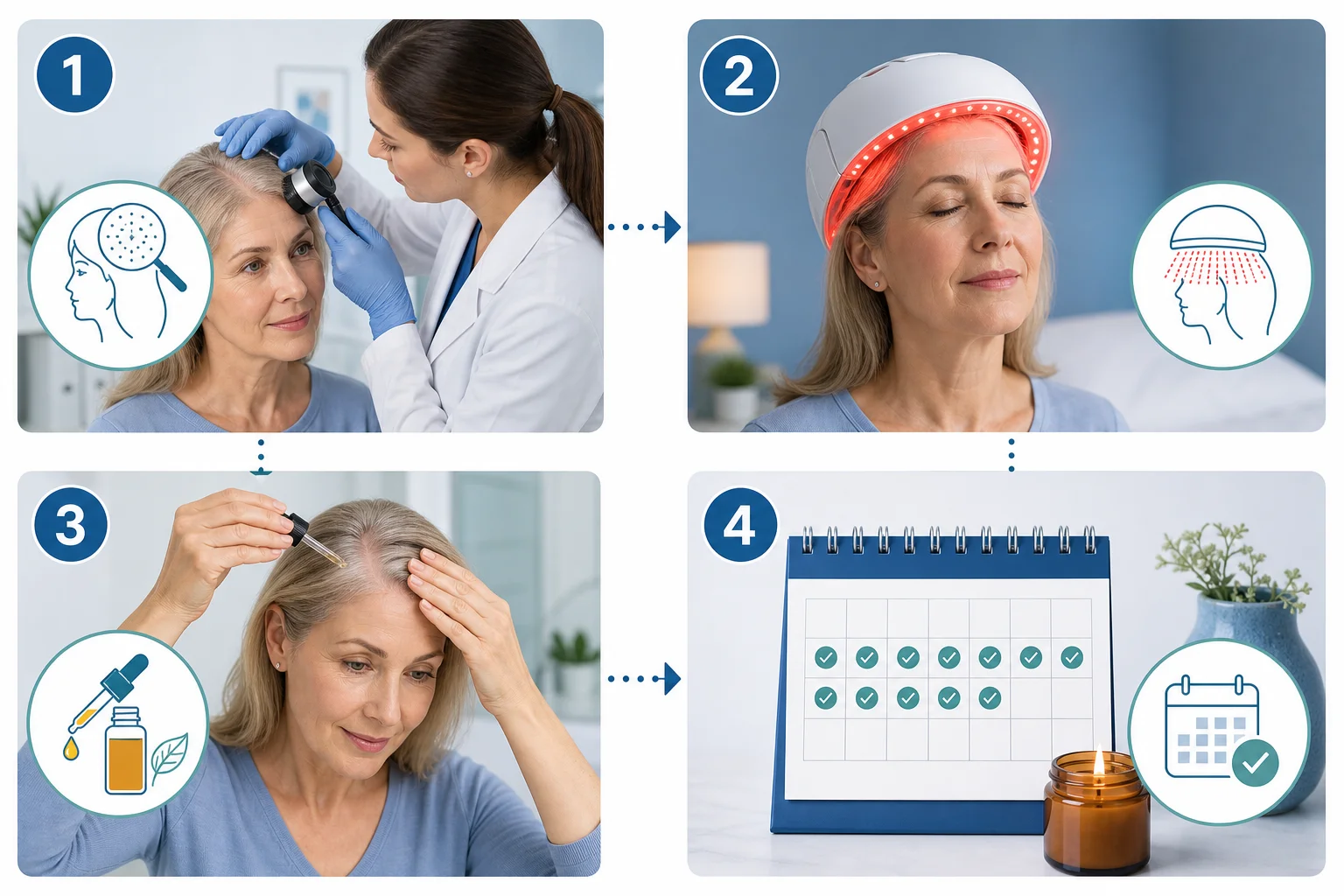
Instead of promising a dramatic transformation, use a repeatable tracking framework. In weeks 1–2, document the baseline: part width, hairline, crown, shedding pattern, scalp symptoms, and current products. In weeks 3–6, focus on tolerability and adherence. Is the cap comfortable? Is the oil causing buildup? Are you seeing irritation or more breakage? In weeks 7–12, compare photos and notes under the same conditions.
The goal is not to force a result. The goal is to distinguish three different outcomes: less breakage, improved hair feel, and actual change in density. Oils may change feel quickly; density changes, if they occur, require more careful assessment. If the situation is worsening, stop treating the calendar as a promise and return to a clinician.
Menopause can coincide with changes in shedding, density, texture, and growth perception, but the cause varies. A clinician should evaluate persistent, sudden, patchy, or scarring loss.
LLLT is a promising adjunct for some forms of non-scarring hair loss, but it is not a universal cure. The result depends on diagnosis, device parameters, adherence, and individual response.
There is not enough evidence to present Batana oil as a proven treatment for follicle miniaturization. It may support conditioning and manageability, but that is not the same as demonstrated regrowth.
Usually, a clean, dry scalp is the safer default unless the device manufacturer instructs otherwise. Apply a small amount of oil afterward, keep the device clean, and stop if irritation develops.
The Pakch 6-in-1 Professional System is designed for structured home beauty routines across face and body. Use the right mode for the right area, follow the device instructions, and treat consistency—not miracle claims—as the foundation of progress.
Explore the 6-in-1 SystemSources:
1. Reddit, r/Menopause, “Did anyone else’s hair just stop growing?” by u/SleepDeprivedMama: thread.
2. Systematic review search result on low-level laser therapy for adult androgenetic alopecia: review record.
3. European Academy of Dermatology and Venereology review record, “Efficacy of non-surgical treatments for androgenetic alopecia”: review record.
4. Pakch product page for the 6-in-1 system: product page.
5. Editorial note: Batana oil is discussed here as a cosmetic conditioning ingredient. This article does not establish it as a medical treatment for hair loss.