The Skincare Habit Nobody Talks About
You double-cleanse your face. You exfoliate on schedule. You apply serums in the correct order, waiting 60 seconds between each layer. Your skincare routine is a carefully calibrated machine.
Now ask yourself this: when was the last time you cleaned the device that touches your face for 10–20 minutes every session?
If your answer is "I rinse it sometimes" or — worse — silence, you are not alone. But you are also undoing a significant portion of your skincare investment. Here is why device hygiene matters more than most people realize, and exactly how to clean each type of beauty device without damaging it.
The Microbiology of Your Beauty Device
A 2023 study published in the Journal of Applied Microbiology swabbed 50 personal care devices (including facial cleansing brushes, LED masks, and RF devices) and found that 72% harbored measurable bacterial colonies, including Staphylococcus aureus and Cutibacterium acnes — the same bacteria implicated in acne and skin infections.
The problem is not that devices are inherently dirty. It is that they create the perfect bacterial environment:
-
Warmth. RF, laser, and LED devices generate heat during use, warming the device surface to temperatures that accelerate bacterial growth.
-
Moisture. Conductive gel, serum residue, and natural skin oils create a thin film on device heads — a nutrient-rich medium for microbes.
-
Dark storage. Most people store devices in bathroom cabinets or drawers — dark, potentially humid environments where bacteria thrive.
-
Infrequent cleaning. Unlike makeup brushes (which most people wash weekly), beauty devices rarely make it onto anyone's cleaning schedule.
| Device Type |
Risk Level |
Primary Contamination Source |
Potential Consequence |
| RF / Cavitation probes |
High |
Conductive gel residue + skin oils |
Acne breakouts, skin irritation |
| Microcurrent rollers |
High |
Conductive gel residue + oxidation |
Reduced conductivity, bacterial transfer |
| LED masks |
Medium |
Skin oils, makeup residue |
Clogged pores, uneven light transmission |
| Laser heads |
Medium |
Dead skin cells, product residue |
Reduced efficacy, skin irritation |
| Gua sha / jade rollers |
Low-Medium |
Facial oil residue |
Bacterial transfer, product buildup |
The Exact Cleaning Protocol by Device Type
RF, Cavitation, and Microcurrent Probes
These are your highest-risk devices because they are used with conductive gel — a water-based medium that is essentially bacterial growth agar if left on the probe head.
After EVERY session:
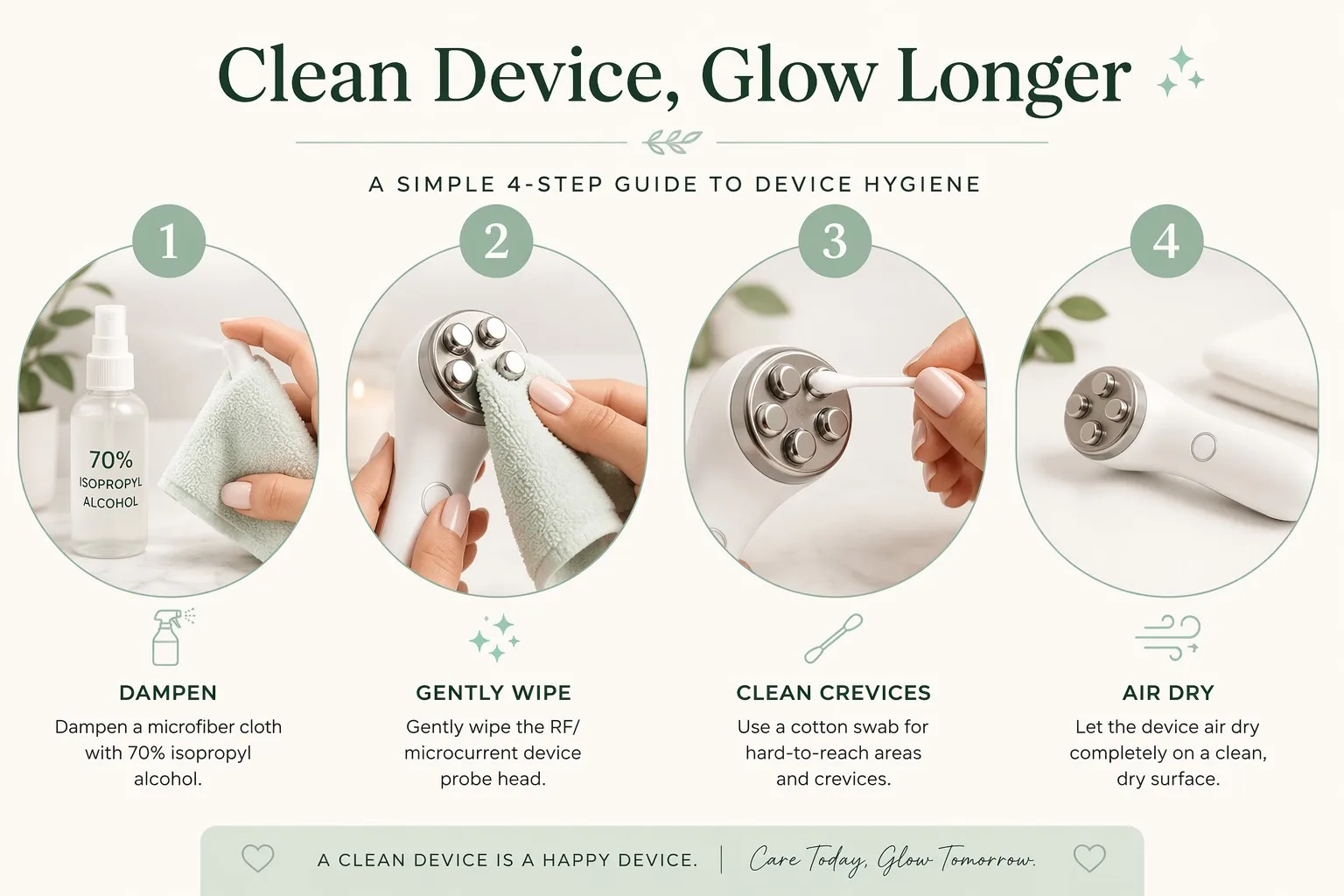
- Dampen a microfiber cloth with 70% isopropyl alcohol (do NOT use anything below 70% — it evaporates too slowly and leaves residue).
- Gently wipe the entire probe head, including crevices around the edges.
- Let air-dry completely (30 seconds) before storing.
- Never submerge the probe in water — most device handles are not fully sealed.
Weekly deep clean:
- Use a cotton swab dipped in isopropyl alcohol to clean the seam where the probe meets the handle — gel residue accumulates here and hardens over time.
- Inspect probe surfaces for pitting, discoloration, or damage. Oxidized metal probes lose conductivity and should be replaced.
LED Masks
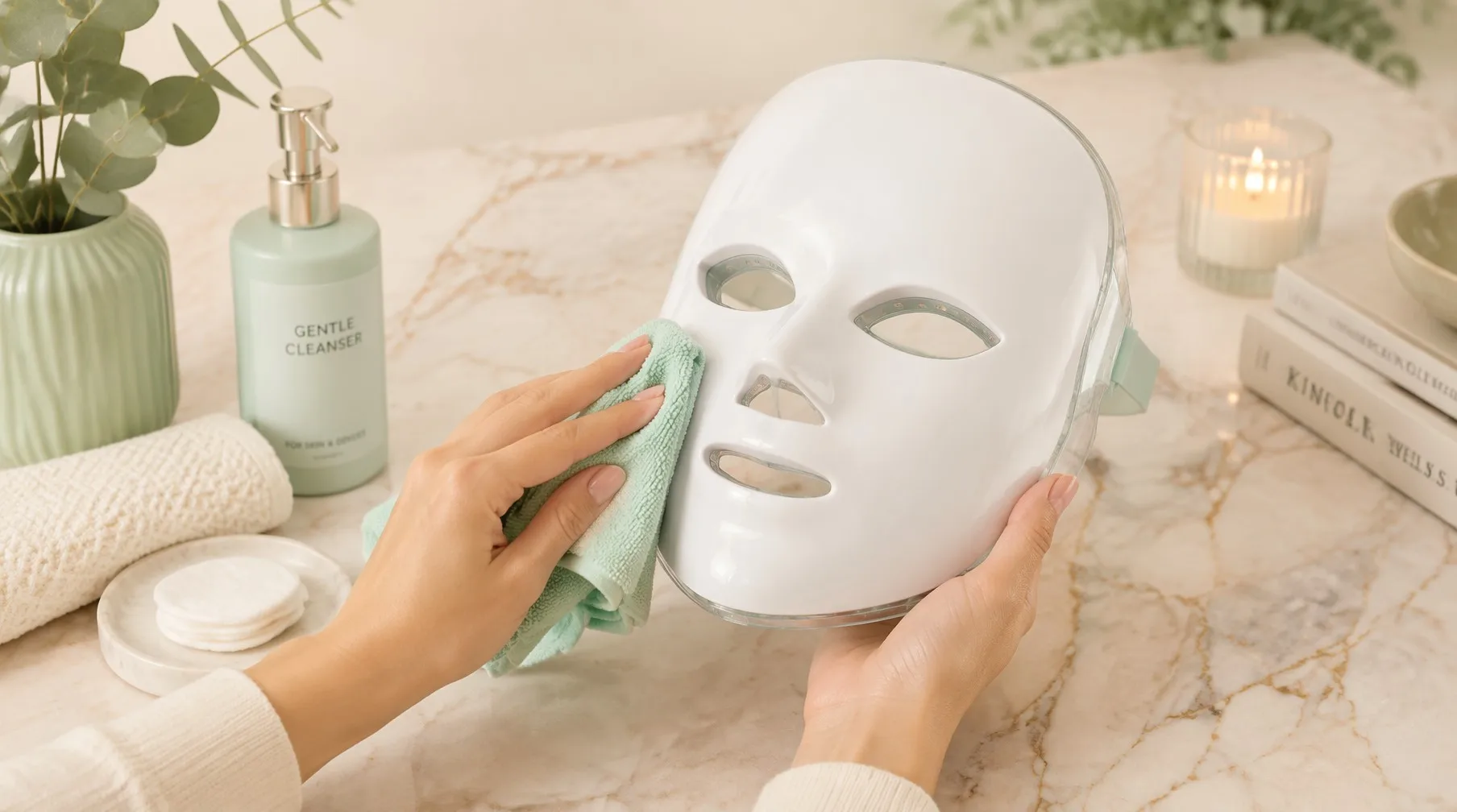
LED masks sit directly against your skin, often for 10–20 minutes. They collect dead skin cells, oil, and any residual skincare product on your face.
After EVERY session:
- Wipe the inner surface (the side touching your face) with a slightly damp microfiber cloth — water only, no alcohol (alcohol can degrade the silicone or plastic housing over time).
- If you wore makeup before using the mask: use a gentle, fragrance-free cleansing wipe first, then the damp cloth.
Weekly:
- Remove and wash any removable silicone eye shields or straps with warm water and mild soap.
- Wipe the outer shell with a dry microfiber cloth to remove dust.
Laser Devices
Laser heads collect dead skin cells and product residue. A dirty laser lens scatters the beam, reducing the energy that reaches your skin — effectively wasting your session.
After EVERY session:
- Use the microfiber cloth that came with the device (or a clean lens cloth).
- Dry-wipe the laser aperture — no liquids unless the manufacturer explicitly permits it. Many laser lenses have anti-reflective coatings that alcohol can strip.
Gua Sha Tools and Jade Rollers
Natural stone tools are porous — they absorb facial oils and can harbor bacteria below the surface.
After EVERY session:
- Wash with warm water and a drop of gentle, fragrance-free soap.
- Pat dry immediately — do not soak.
Weekly:
- Wipe with 70% isopropyl alcohol for disinfection.
- Inspect for chips or cracks — damaged stone can scratch your skin.
The Storage Rules That Keep Devices Clean Between Sessions
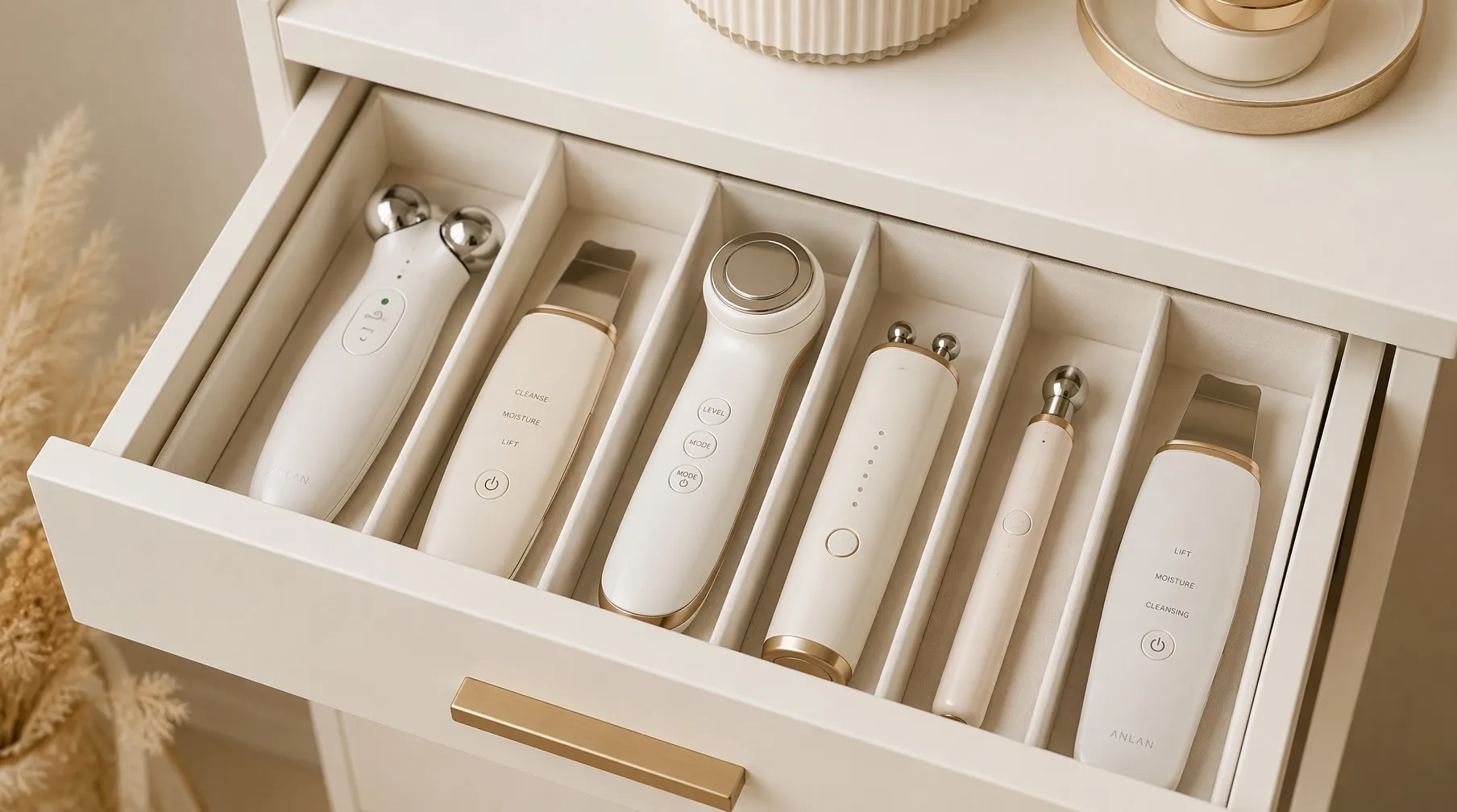
Cleaning is only half the equation. How you store your device determines whether it stays clean or recolonizes within hours.
-
Do not store devices in the bathroom. Steam from showers creates a humid environment that encourages bacterial growth on device surfaces, even after cleaning. Store in a bedroom drawer or vanity instead.
-
Use the original case or a dedicated pouch. Loose devices in a drawer collect dust, shed skin cells, and rub against other objects that can scratch probe surfaces.
-
Store probes facing up. If your device has a stand or case that holds it upright, use it. Probes stored face-down on any surface will collect whatever is on that surface.
-
Replace conductive gel bottles regularly. An open bottle of gel is a bacterial time bomb. Most professional-grade gels have a PAO (Period After Opening) symbol on the label — typically 6–12 months. Write the date you opened it on the bottle with a marker.
-
Never share devices. This should go without saying, but dermatologists report cases of staph infections traced back to shared beauty devices. Even among family members, each person should have their own probe heads or clean the device thoroughly between users.
Signs Your Device Needs Replacement (Not Just Cleaning)
No cleaning routine can extend a device's life indefinitely. Here are the signs that it is time to replace probe heads — or the entire device:
-
Visible pitting or roughness on metal probe surfaces — this creates micro-abrasions on your skin and reduces conductivity.
-
Fading or uneven LED output — individual LED bulbs have a rated lifespan of 10,000–50,000 hours, but power drivers can fail sooner.
-
Reduced sensation or effectiveness — if your RF device feels cooler than it used to, or your microcurrent device feels weaker at the same setting, the internal components may be degrading.
-
Cracks in silicone or plastic housing — any breach in the device body is a safety hazard, especially for electrical devices used on damp skin.
-
Persistent odor even after cleaning — this indicates bacterial colonization below the surface, often in crevices that cannot be reached with surface cleaning.
The Bottom Line
Device hygiene is not a nice-to-have — it is part of the treatment. The same clinical logic that says you should apply serums to clean skin applies to the device delivering energy into that skin.
The rule of thumb: clean your device every single time you use it. The routine takes 30 seconds. The alternative — transferring weeks of accumulated bacteria onto freshly cleansed skin — is undoing your entire skincare investment in less time than it takes to apply your moisturizer.
And if you are using a conductive gel with your RF, cavitation, or microcurrent device, make sure you are starting with a clean, medical-grade gel — not a months-old open bottle. Your skin deserves the same standard of hygiene from your devices that it gets from your skincare routine.