

0 item(s)
View cart
You have no items in your shopping cart.
If you have ever used a microcurrent device, you know the feeling. You glide the metal probes across your jawline for 10 minutes, glance in the mirror, and think: wow, it actually worked. Your cheekbones look sharper. Your brows sit higher. Your jawline has definition it did not have yesterday.
Then you wake up the next morning and it is gone.
This is not your imagination — and it is not failure. That temporary lift is actually proof the technology works. The problem is that most people stop there, never progressing to the cumulative, long-term results that clinical studies document after 8 to 12 weeks of consistent use.
The gap between "it worked for an afternoon" and "my face looks 5 years younger" comes down to understanding exactly what microcurrent does inside your skin — and what it cannot do.
The single biggest misunderstanding about microcurrent: it is often marketed as "facial muscle toning" or "a workout for your face." That framing is misleading.
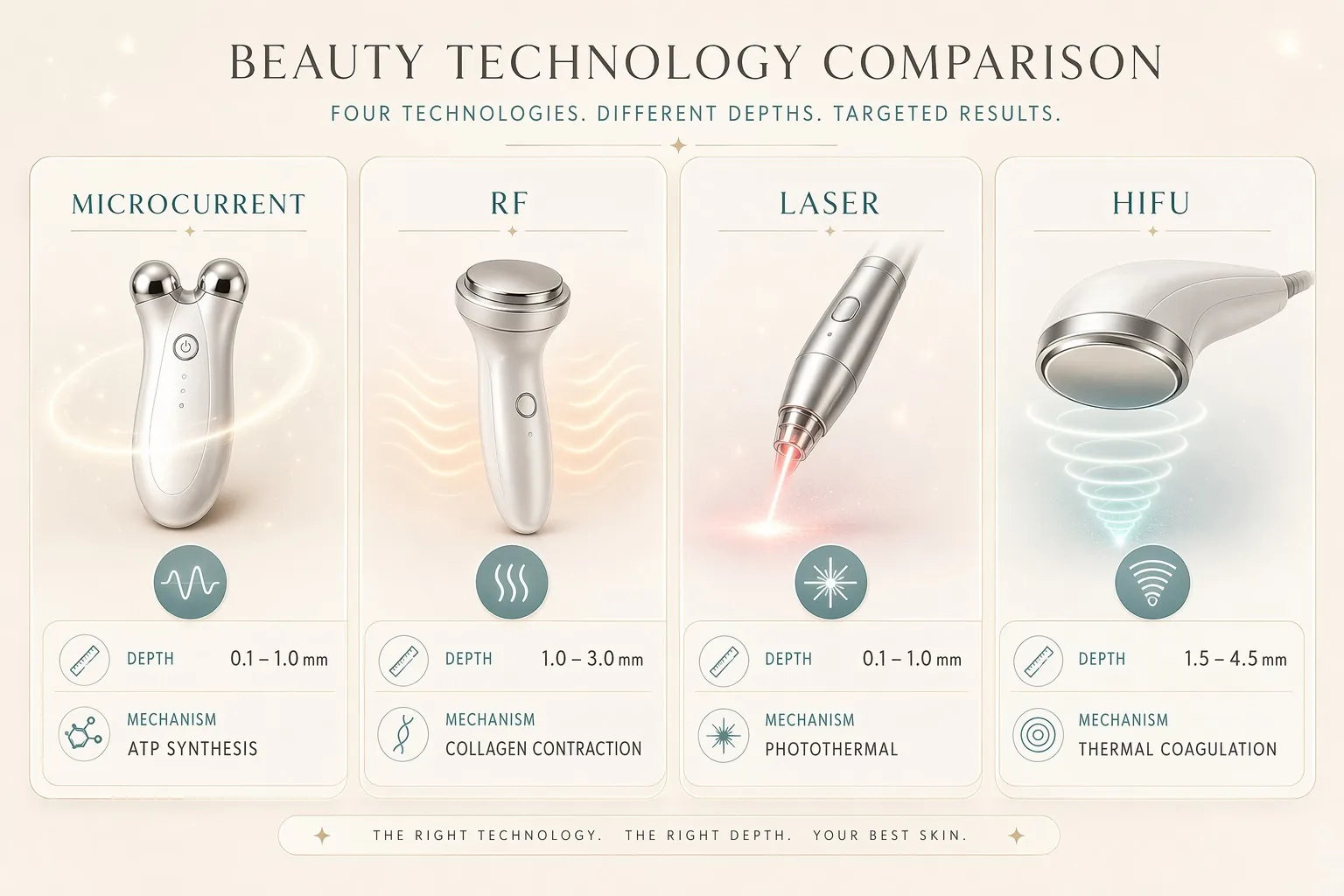
Microcurrent delivers extremely low-level electrical currents — measured in microamps (µA), typically between 25 and 600 µA — that mimic the body's own natural bioelectric signals. Unlike EMS (Electrical Muscle Stimulation), which triggers visible muscle contractions, microcurrent operates below the sensory threshold. You should not feel your muscles twitch. If you do, the intensity is too high, and you have crossed into EMS territory — a completely different mechanism with different results.
| Technology | Current Level | Mechanism | Sensation | Primary Result |
| Microcurrent | 25–600 µA | ATP synthesis, amino acid transport | None or very mild | Collagen/elastin regeneration over weeks |
| EMS | Milliamp range | Direct motor nerve stimulation | Visible muscle contractions | Temporary muscle toning |
| RF | Radio frequency (thermal) | Collagen denaturation → remodeling | Warmth/heat | Skin tightening |
| LED | Light energy (mW) | Cellular photobiomodulation | None | Reduced inflammation, collagen support |
This table matters because a device marketed as "microcurrent" that makes your face visibly jump is almost certainly delivering EMS — and that means you are not getting the ATP and collagen benefits.
The scientific rationale for microcurrent centers on a molecule called adenosine triphosphate (ATP) — the energy currency of every cell in your body. Here is the chain of events that clinical research supports:
This is why the "24-hour lift" is real but temporary — it is primarily the result of improved circulation and temporary facial muscle repositioning, not structural change. The structural change takes weeks because it requires your fibroblasts to actually build new collagen matrix.
One of the most contentious debates on Reddit (r/30PlusSkinCare, r/SkincareAddiction) is whether at-home microcurrent devices can deliver results comparable to in-office treatments.
Professional microcurrent machines (used by estheticians) typically deliver 300–600 µA with dual-probe configurations and trained operator technique. In a 2020 split-face study published in the Journal of Clinical and Aesthetic Dermatology, professional microcurrent treatments over 8 weeks produced measurable improvements in skin laxity, with 85% of participants showing visible lifting at the jawline.
At-home devices (NuFace, Foreo Bear, Ziip, and professional-grade home units) operate in the 25–400 µA range. The lower ceiling is intentional — it reduces risk for untrained users. Here is what Reddit users consistently report:
"Used NuFace Mini for 60 days, took photos every week. At week 4 I almost quit because I saw nothing. At week 8 the difference was undeniable. Patience is the entire game." — Reddit user, r/30PlusSkinCare
"The key variable nobody talks about is conductive gel quality. I used aloe vera gel for 2 months and got nothing. Switched to a proper ultrasonic gel and the device finally glided properly and conductivity was night-and-day different." — Reddit user, r/SkincareAddiction
The consensus from both clinical literature and user experience:
If there is one thing Reddit beauty-device threads agree on unanimously, it is this: most microcurrent devices end up in drawers because of conductive gel hassle.
This friction is significant enough that a 2025 consumer survey by Spate reported that 41% of home beauty device owners use their devices less than once per week — not because they do not believe in the technology, but because the preparation and cleanup feel disproportionate to a 5–10 minute treatment.
Solutions that actually work:
Following the same evidence-based framework as our RF skin tightening schedule, here is the optimal microcurrent protocol derived from clinical studies:
Why "every day" does not accelerate results. The fibroblast's collagen synthesis cycle runs on approximately 48–72 hours. Stimulating the same cells again before they have completed one full synthesis cycle does not produce more collagen — it just fatigues the tissue. This is the same physiological constraint we discussed in our RF frequency guide, and it applies to microcurrent as well.
What about skipping days? An occasional missed session will not derail progress. But if you drop below 2 sessions per week during Phase 1, expect results to take 12–16 weeks instead of 8.
Not every face is a candidate. Contraindications include:
Here is where at-home beauty technology gets genuinely powerful — and where single-device users leave results on the table.
Microcurrent, RF, and LED target three completely different physiological mechanisms:
| Technology | Target Depth | Mechanism | Timeline to Results |
| Microcurrent | Epidermis to upper dermis | ATP synthesis → fibroblast activation | 8–12 weeks |
| RF | Mid to deep dermis | Thermal collagen denaturation → remodeling | 4–8 weeks |
| LED (Red/NIR) | Epidermis to dermis | Photobiomodulation → reduced inflammation, ATP support | 4–12 weeks |
They do not conflict. In fact, LED therapy performed before microcurrent has been shown to enhance ATP availability, potentially amplifying the microcurrent effect. And RF addresses the deeper dermal layer that microcurrent cannot reach, producing structural tightening that complements microcurrent's surface-level lifting.
A multi-technology device — like a clinical-grade system that integrates cavitation, RF, LED, and vacuum therapy into one protocol — eliminates the sequencing guesswork entirely.
Microcurrent is not magic, but the mechanism is real. Clinical evidence supports measurable increases in ATP production, fibroblast activity, and dermal collagen density when the technology is used correctly — meaning: consistent sessions, full skin contact, quality conductive medium, and realistic expectations about timeline.
What microcurrent does well:
What microcurrent does not do:
If you are willing to commit to a structured protocol and treat the technology with the same discipline you would apply to a gym routine — not expecting results in week one, but trusting the cumulative biology — microcurrent is one of the most underutilized tools in the at-home beauty arsenal.