

0 item(s)
View cart
You have no items in your shopping cart.
Scroll through TikTok or Instagram for five minutes and you will encounter the term "HIFU facelift" at least once. The before-and-after photos are dramatic: jawlines sharpened, jowls lifted, nasolabial folds softened. The comments are split between "this changed my life" and "I felt nothing for $500."
The truth sits somewhere in between — and it comes down to a single variable that most marketing conveniently ignores: depth.
We analyzed clinical studies, dermatologist protocols, and hundreds of Reddit threads to understand when HIFU actually works, when it fails, and why the device you buy matters far less than the anatomical layer it reaches.
The single biggest misunderstanding in at-home beauty technology is treating all skin-tightening devices as interchangeable. They are not. HIFU, RF, laser, and microcurrent operate through completely different physical mechanisms at completely different depths.
HIFU (High-Intensity Focused Ultrasound) delivers concentrated ultrasound energy that passes through the epidermis without damaging it, then converges at a precise focal point within the deeper tissue. Think of a magnifying glass focusing sunlight onto a single point — the glass itself is cool, but the focal point burns. HIFU uses the same principle: the skin surface stays intact while thermal energy concentrates at depths of 1.5mm, 3.0mm, or 4.5mm below the surface.
At the focal point, temperatures reach 60–70°C (140–158°F) for less than one second. This creates controlled thermal coagulation points — microscopic zones of tissue remodeling that trigger the body's wound-healing cascade. Fibroblasts rush to the area and begin producing new collagen and elastin over the following 8–12 weeks.
| Technology | Energy Type | Target Depth | Mechanism | Results Timeline |
| HIFU | Focused ultrasound | 1.5–4.5 mm (SMAS layer) | Thermal coagulation → collagen remodeling | 3–6 months |
| RF | Radio frequency (electrical) | 1.0–3.0 mm (dermis) | Volumetric heating → collagen contraction | 1–3 months |
| Laser | Coherent light | 0.1–1.0 mm (epidermis to upper dermis) | Photothermal ablation or coagulation | 1–3 months |
| Microcurrent | Low-level electrical (µA) | Epidermis to upper dermis | ATP synthesis → fibroblast activation | 2–3 months |
This depth difference is not academic — it determines which aging concerns each technology can address.
To understand why HIFU commands a premium price point (and delivers premium results when used correctly), you need to understand the SMAS.
The Superficial Musculoaponeurotic System (SMAS) is a continuous fibromuscular layer that sits approximately 4.5mm beneath the skin surface on the face. It connects the facial muscles to the overlying skin. In a surgical facelift, the surgeon physically lifts and repositions the SMAS — that structural repositioning is why surgical results are so dramatic.
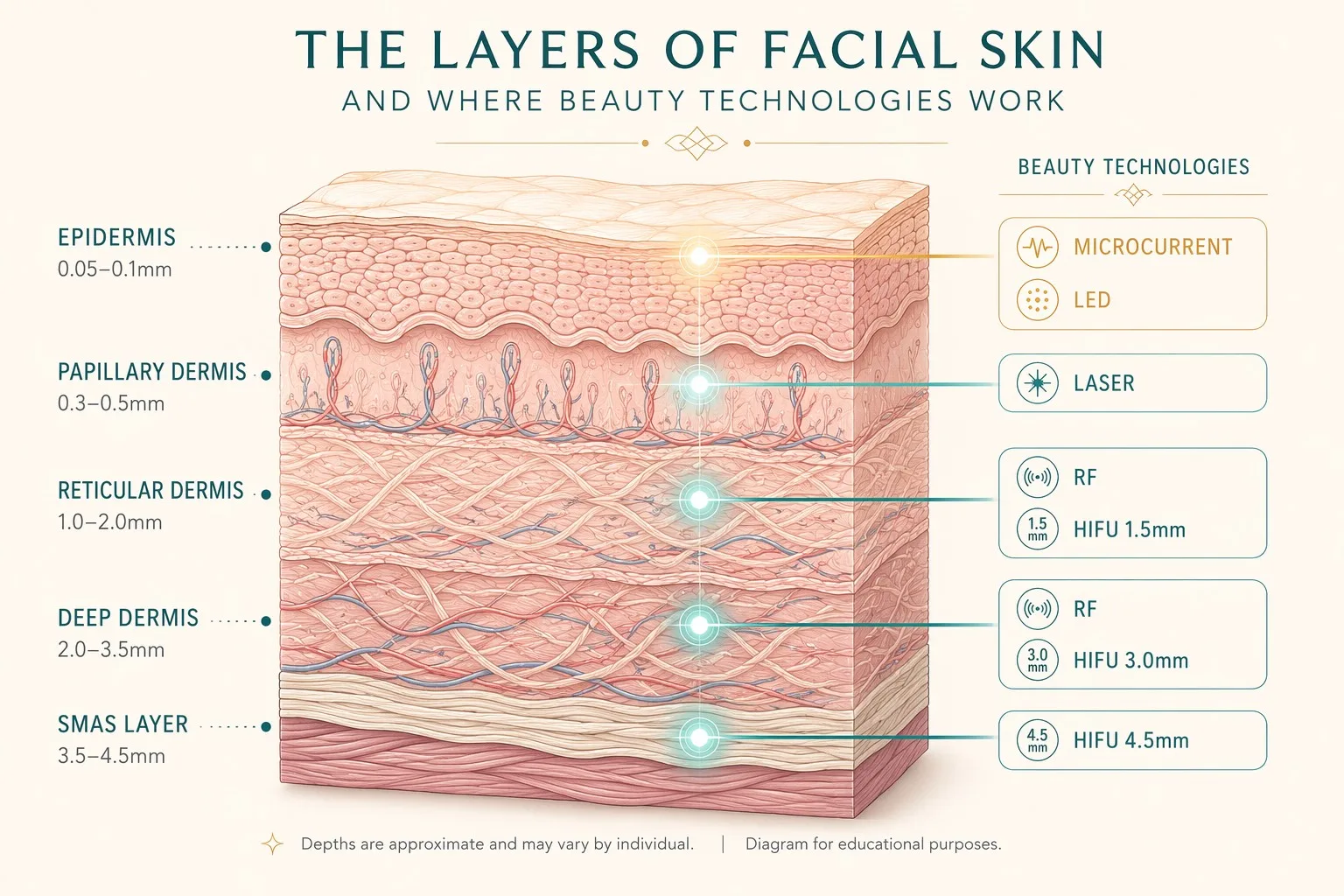
| Skin Layer | Approximate Depth | Can Be Reached By | What It Treats |
| Epidermis | 0.05–0.1 mm | Microcurrent, LED, topical skincare | Surface texture, tone |
| Papillary dermis | 0.3–0.5 mm | Microcurrent, LED, laser | Fine lines |
| Reticular dermis | 1.0–2.0 mm | RF, laser, HIFU (1.5mm cartridge) | Wrinkles, skin laxity |
| Deep dermis / subdermis | 2.0–3.5 mm | RF, HIFU (3.0mm cartridge) | Moderate sagging, jowls |
| SMAS | 3.5–4.5 mm | HIFU (4.5mm cartridge) ONLY | Significant lifting, structural sagging |
This is why the "HIFU facelift" moniker exists — it is the only energy-based treatment that mechanically reaches the same anatomical plane that surgeons manipulate. It does not replace surgery, but for mild-to-moderate skin laxity, the results can be meaningful.
Here is the uncomfortable truth that most at-home HIFU manufacturers do not want you to Google: not all HIFU reaches 4.5mm.
Professional HIFU devices (Ultherapy, Ultraformer III, Doublo) use medical-grade transducers with real-time ultrasound imaging to verify the exact focal depth before each pulse. They deliver energy at precisely 1.5, 3.0, or 4.5mm with microsecond-level pulse timing. A 2021 systematic review in the Journal of Cosmetic Dermatology analyzing 32 clinical studies found that professional HIFU produced significant improvements in skin laxity in 80–90% of patients, with results peaking at 3–6 months post-treatment.
At-home HIFU devices operate at lower energy levels and — critically — often cannot verify their actual focal depth. Reddit discussions reveal a consistent pattern:
"My at-home HIFU device has 3 cartridges labeled 1.5mm, 3.0mm, 4.5mm. But my esthetician friend tested it and said the actual focal depth is nowhere near the label. The 4.5mm cartridge is probably hitting 2.5mm at best." — Reddit user, r/30PlusSkinCare
"Three sessions with a professional Ultherapy machine gave me more visible lifting than 6 months of at-home HIFU. The depth control is the entire game. If your device can't verify depth, you're paying for a fancy RF machine." — Reddit user, r/SkincareAddiction
The consensus from both clinical literature and user experience is nuanced but clear:
If you have watched HIFU treatment videos, you have seen people wincing. The discomfort is real — and understanding why is important for setting expectations.
When ultrasound energy converges at 4.5mm and hits the SMAS, the periosteum (the membrane covering facial bones) is very close. Some pulses inevitably graze the periosteum, which is richly innervated. The sensation is described as brief, sharp zaps — not burning, not prolonged aching. Most patients rate professional HIFU pain at 4–6 on a 10-point scale, with the 4.5mm cartridge on bony areas (jawline, brow bone) being the most intense.
The pain correlation with results: Clinically, the pulses that cause discomfort are often the ones hitting the right depth. If a HIFU treatment is completely painless at the 4.5mm setting, the energy is either too low or the focal point is shallower than claimed. This is not to say you should seek out painful treatments — but a pain-free "4.5mm HIFU" should raise questions.
HIFU is fundamentally different from RF or microcurrent in one critical way: it works through controlled thermal injury, not cumulative stimulation. This means the protocol is completely different from what we recommend for other technologies.
The biggest mistake people make with HIFU: treating it like RF and doing weekly sessions. Over-treating HIFU leads to the same risk as over-treating RF — facial fat loss. The dermis and SMAS are not the only tissues at the focal depth; subcutaneous fat sits in the same 3–4.5mm zone. Too much thermal energy too frequently can cause unintended adipocyte (fat cell) apoptosis, leading to hollowing — a side effect that is, notably, not reversible without filler or fat transfer.
The contraindication list for HIFU is slightly longer than for surface-level technologies because the energy penetrates so deeply:
If our microcurrent and RF articles have a central thesis, it is this: no single technology treats every skin layer. HIFU completes the depth spectrum:
| Technology | Depth Reached | Best For | Frequency |
| Microcurrent | Epidermis to upper dermis (0.1–1.0mm) | Surface tone, fine lines, muscle re-education | 3–5x per week |
| RF | Mid to deep dermis (1.0–3.0mm) | Skin laxity, collagen contraction, texture | 2–3x per week |
| HIFU | Deep dermis to SMAS (1.5–4.5mm) | Structural lifting, jowls, significant sagging | Every 4–6 weeks |
These technologies are complementary, not competitive. A clinical-grade multi-technology device that integrates RF, cavitation, LED, and vacuum therapy handles the dermal and surface layers, while HIFU sessions (professional or high-quality at-home) address the SMAS layer on a completely different timeline.
The optimal stack for someone with mild-to-moderate skin laxity might look like:
HIFU is the deepest-reaching non-invasive skin tightening technology available — and that depth is both its greatest strength and its greatest risk.
What HIFU does well:
What HIFU does not do:
If you are considering HIFU, the single most important question to ask is not about wattage or cartridge count — it is this: can this device verify its actual focal depth? Without that verification, "4.5mm HIFU" is a marketing claim, not a clinical reality.