

0 item(s)
View cart
You have no items in your shopping cart.

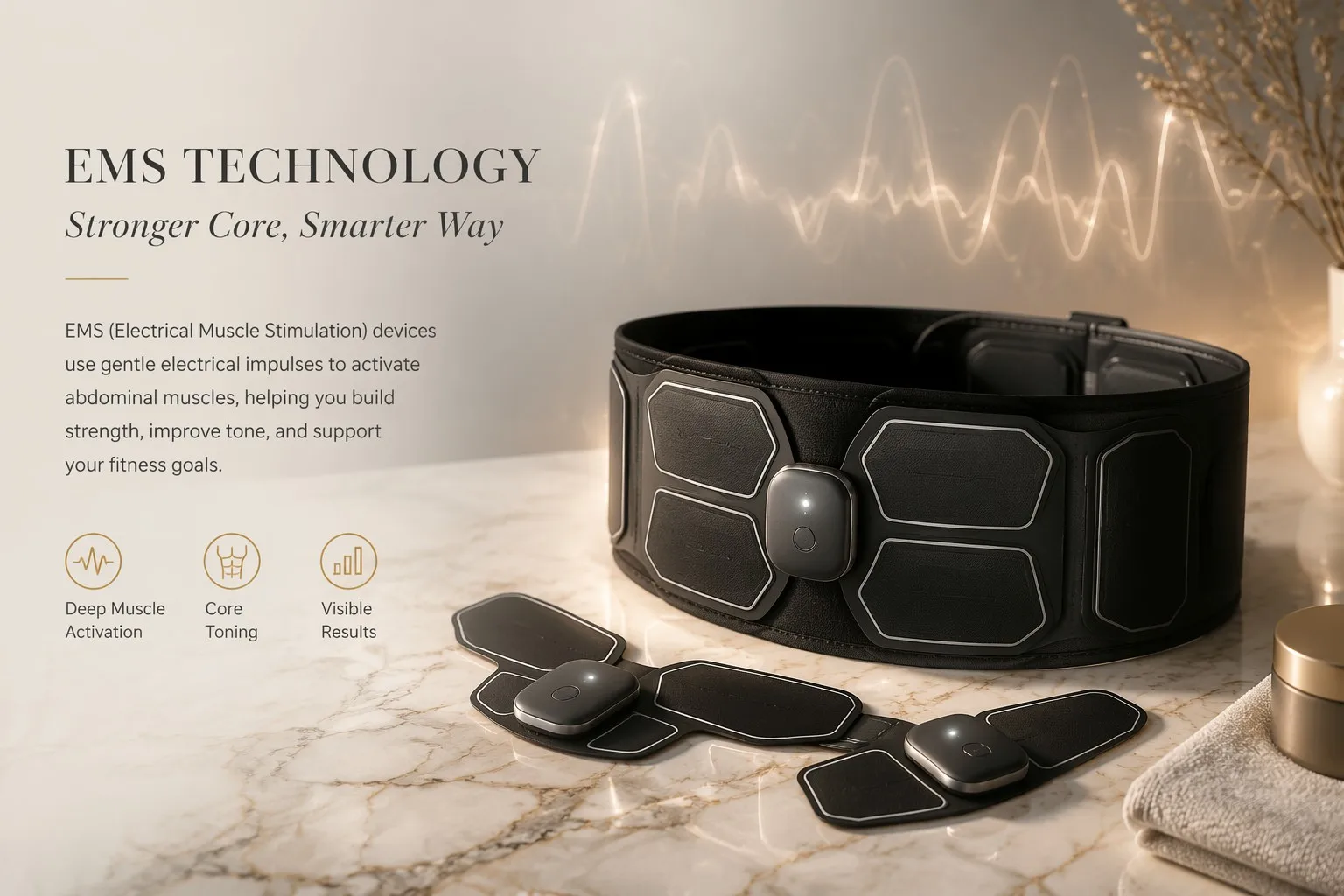
Type "ab stimulator" into Reddit and the first thing you will find is not testimonials. It is this:
"This is a military-grade scam written in precision tactical language engineered to make you buy this product within 10 minutes."
— r/Scams, on ab stimulator marketing
Fair. The cheap $30 belts on Amazon that promise six-pack abs while you sit on the couch? Those are scams. They deliver a mild tingling sensation, do nothing for muscle growth, and rely entirely on the fantasy that you can build muscle without effort.
But here is where the story gets interesting: there is a massive difference between a $30 scam belt and clinical-grade EMS technology.
The same technology that physical therapists use to prevent muscle atrophy in bedridden patients, that elite athletes use for recovery, and that the FDA has cleared for muscle stimulation — that is real EMS. And when delivered at sufficient power levels, it builds muscle in ways that exercise alone cannot.
"I tried one of these devices out of curiosity — wasn't expecting miracles, but was surprised it actually made my glutes sore the next day. It recruits muscles you didn't even know you had."
— r/workout user, on TikTok EMS butt-lifting device
This is the single biggest source of confusion. People use the terms interchangeably, but they are fundamentally different technologies with different goals:
| Feature | TENS | EMS |
|---|---|---|
| Purpose | Pain relief | Muscle contraction and growth |
| Target | Sensory nerves (to block pain) | Motor nerves (to make muscles contract) |
| Frequency | High frequency, low intensity | Low frequency, high intensity |
| Physical effect | Tingling, numbness | Visible muscle contraction |
| Builds muscle? | No | Yes (at sufficient power) |
TENS says to your nerves: "stop sending pain signals." EMS says to your muscles: "contract. Now. Hard." That is a completely different instruction set.
When you perform a crunch, your brain sends an electrical signal down your spinal cord, through your motor nerves, to your abdominal muscles. The muscles contract. Over time, with enough contraction and resistance, they grow.
EMS short-circuits this process. Instead of waiting for your brain to initiate the signal, the device delivers the electrical impulse directly to the motor nerve. Your muscle contracts exactly as it would during exercise — it just does not involve your brain, your willpower, or your spine.
Two things make this uniquely powerful:
When you contract a muscle voluntarily, your brain activates muscle fibers in a specific order: Type I (slow-twitch) first, then Type IIa (intermediate), then Type IIx (fast-twitch, the fibers that produce the most growth). You only reach Type IIx fibers during very intense, near-maximal effort.
EMS reverses this recruitment order. Because electrical stimulation activates motor nerves directly — not through the brain — it triggers Type IIx fibers first, then Type IIa, then Type I. This means EMS can stimulate the most growth-responsive muscle fibers in a way that even heavy weightlifting cannot easily replicate.
This is why EMS is used in professional sports medicine: it reaches fibers that conventional training leaves under-stimulated.
A "supramaximal" contraction is stronger than what you can achieve voluntarily. When your brain tells your bicep to curl a dumbbell, it limits the contraction force to protect your tendons and joints. EMS bypasses this protective inhibition, allowing the muscle to contract at close to 100% of its maximum possible force — far beyond what you could voluntarily generate.
No. And anyone who tells you otherwise is selling you the $30 Amazon belt we talked about earlier.
EMS builds muscle. It does not burn the fat covering that muscle. A person with 25% body fat using EMS religiously will develop stronger, firmer abdominal muscles — but those muscles will remain invisible under the fat layer. You cannot spot-reduce fat with electrical stimulation.
EMS works best as a complement to exercise, not a replacement. Used alongside strength training, it amplifies results by stimulating fibers that conventional training misses. Used for recovery, it increases blood flow and reduces soreness between workouts.
This is the comparison Reddit users obsess over. EmSculpt Neo (the gold-standard professional EMS machine) costs $750-$1,000 per session and is proven to increase muscle mass by 25% with RF-assisted fat reduction. At-home EMS devices have a fraction of that power.
But Reddit user consensus is clear: consistency compensates for lower power.
"EMSzero works. It seems to be about 70% of the strength of EmSculpt Neo. All the before and after pictures prove it is effective. You just need to use it more frequently."
— r/Emsculpt user, comparing at-home EMS to professional treatment
| Factor | EmSculpt Neo (Clinic) | At-Home EMS Device |
|---|---|---|
| Power per session | Maximum | ~70% of maximum |
| Sessions needed | 4-6 (1x/week) | 8-12 (2-3x/week) |
| Cost | $3,000-$6,000 total | Device purchase only |
| Muscle increase | ~25% | 10-16% (with consistency) |
EMS is not limited to abs. The same technology can be applied (with appropriate pad placement) to virtually any major muscle group:
💡 Pro Tip: The best results come from using EMS immediately after your workout, on the muscles you just trained. The muscles are already fatigued and primed for additional stimulation. This is called "EMS potentiation" and is standard protocol in professional athletics.
If you expect a gentle massage-like vibration, adjust your expectations. At effective power levels, EMS feels like an intense, involuntary muscle contraction — because that is exactly what it is.
Users describe the sensation as a deep, rhythmic squeezing that intensifies as you increase the power. At lower levels, it feels like a strong twitch. At therapeutic levels, your muscle visibly contracts and you cannot voluntarily relax it — the device is in control. There is no pain, but there is definite effort. Your muscle is working, whether your brain approved it or not.
Post-session soreness (DOMS) is common and expected — the same soreness you get after a hard gym session. This is actually a good sign: it means your muscle fibers experienced enough stimulus to trigger the repair-and-growth cycle.
EMS is FDA-cleared and has been used safely in physical therapy for decades. But there are important contraindications:
| Do NOT use EMS if: | Why |
|---|---|
| You have a pacemaker or defibrillator | Electrical interference can disrupt cardiac devices |
| You are pregnant | Effects on fetal development are not studied; avoid abdominal use |
| Over the heart or carotid arteries | Never place electrodes on the chest, neck, or head |
| On broken, irritated, or infected skin | Electrodes require clean, intact skin for safe conduction |
The limitation of standalone EMS is obvious: it builds muscle but does not remove the fat covering that muscle. The limitation of standalone cryo is also obvious: it removes fat but does nothing for the muscle definition underneath.
This is why clinics charge premium prices for machines like EmSculpt Neo — which combines EMS with RF to simultaneously build muscle and reduce fat. And this is why an at-home device that integrates EMS + cryo + cavitation + RF + LED + laser follows the exact same clinical logic: each technology compensates for the limitations of the others.
| Technology | What It Does | Limitation | Solved By |
|---|---|---|---|
| EMS | Builds muscle, improves definition | Does not remove fat layer | Cryo + Cavitation |
| Cryo | Freezes and eliminates fat cells | Can leave loose skin | RF |
| RF | Tightens skin, stimulates collagen | Does not reduce fat volume | Cryo + Cavitation |
| LED + Laser | Cellular repair, skin quality | No fat/muscle effect | EMS + Cryo + RF |
Is EMS a scam? The $30 belts are. But clinical-grade EMS — the technology that physiotherapists, pro athletes, and the FDA have relied on for decades — is not. It builds muscle by recruiting fibers that voluntary exercise cannot easily reach, producing contractions stronger than your brain will allow.
The catch: results require power, consistency, and realistic expectations. EMS will not give you abs if you have a layer of fat covering them. It will not replace your gym membership. But used consistently at sufficient intensity — ideally as part of a multi-technology approach that also addresses fat and skin — it will build firmer, more defined muscles in ways that conventional training alone cannot match.
The 6-in-1 system integrates EMS muscle toning with cavitation, RF, cryo, LED, and laser — the same multi-technology logic that makes EmSculpt Neo the gold standard in clinics.
Explore the 6-in-1 SystemFree Worldwide Shipping | 30-Day Money Back Guarantee
Sources: Reddit communities r/Emsculpt, r/workout, r/Scams, r/flexibility; FDA 510(k) clearances for EMS devices; clinical literature on EMS muscle recruitment and Type IIx fiber activation. Individual results vary. EMS is not a substitute for a healthy diet and exercise program.