

0 item(s)
View cart
You have no items in your shopping cart.

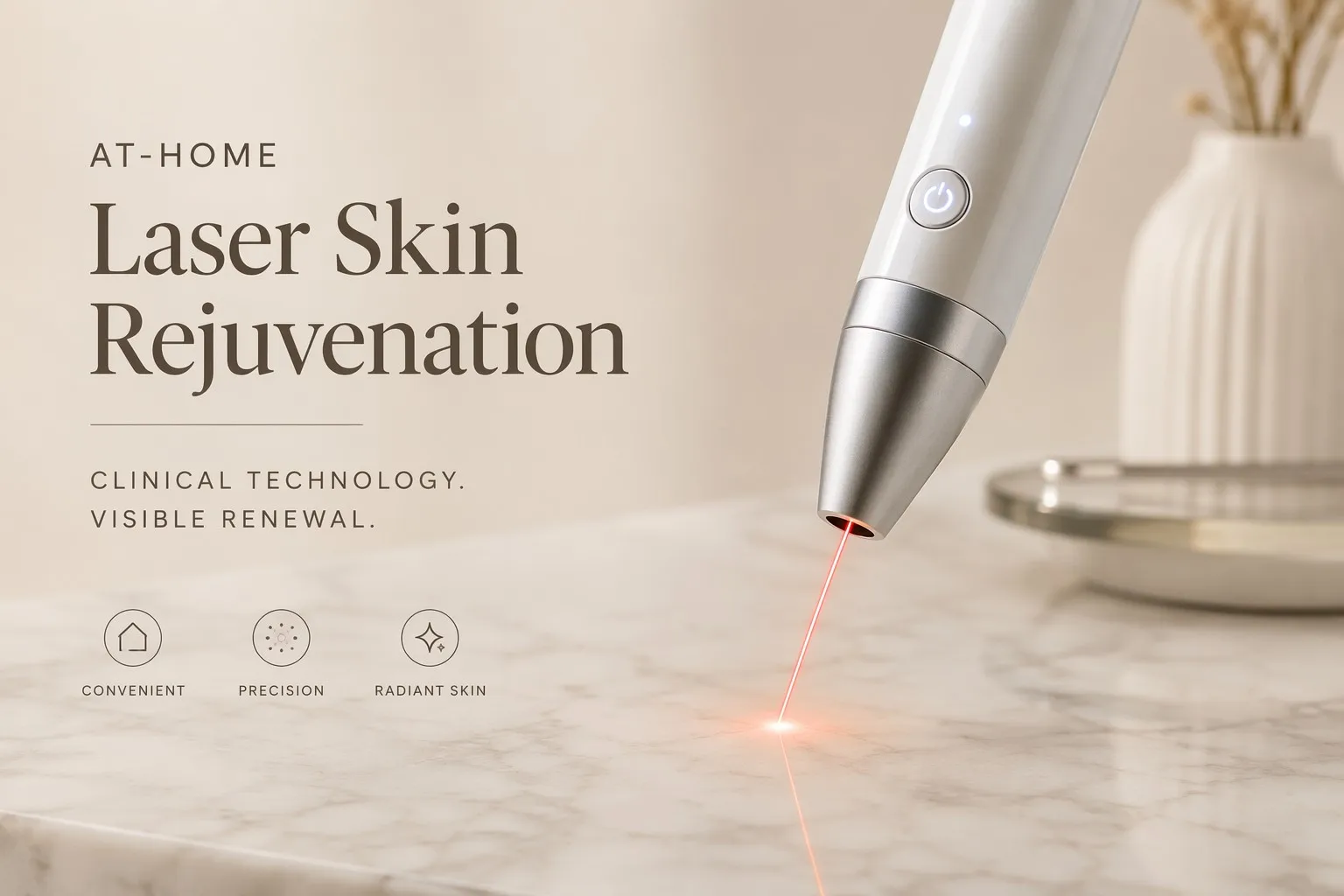
The most common mistake in at-home skincare technology is treating "laser" and "LED" as the same thing. They are not even close.
| Feature | LED | Laser |
|---|---|---|
| Light type | Incoherent, scattered light | Coherent, focused beam |
| Energy density | Low (mW range) | High (significantly more concentrated) |
| Mechanism | Photobiomodulation — gentle cellular energy boost | Photothermal — controlled heating of tissue |
| Effect | Gradual collagen stimulation over weeks | Immediate tissue tightening + long-term collagen remodeling |
| Safety | Very safe for home use | Requires caution, technique, and protective eyewear |
LED is like sitting in warm sunlight. Laser is like focusing that sunlight through a magnifying glass. One provides gentle, diffuse energy. The other concentrates it into a powerful, targeted beam. Both have therapeutic value — but they operate on fundamentally different principles.
At-home lasers use non-ablative technology. This means they heat the dermis (the deeper skin layer) without damaging the epidermis (the surface layer). The controlled heat triggers three biological responses:
Professional laser treatments use higher power and ablate (remove) the surface skin layer, requiring downtime and healing. At-home devices are deliberately lower-powered to avoid this, trading speed for safety. The results are more gradual — but achievable with consistency.
"The laser function on my device is the one I was most afraid of, but it is actually the most immediately satisfying. I can feel the skin tightening within minutes. I use it on my abdomen and inner thighs after cavitation."
— r/bodysculptors user
Laser users consistently report the fastest perceived results compared to other non-invasive technologies. The immediate collagen contraction provides a visible "snap" that LED and RF alone do not deliver in a single session. However, this comes with the highest safety requirements of any at-home beauty technology.
Laser energy is absorbed by melanin. This means darker skin tones absorb more laser energy and are at higher risk for burns and hyperpigmentation. If you have Fitzpatrick skin type IV or above (olive to dark skin tones), use laser at the lowest power setting and extend the interval between sessions. Some dermatologists recommend against at-home laser use for skin types V-VI without professional supervision.
The safest way to use at-home laser is as part of a multi-technology rotation, not as a standalone treatment. Here is why:
A typical weekly rotation might look like: Monday (Cavitation + RF), Wednesday (Laser + LED), Friday (Cryo + EMS). This distributes the treatment load across multiple biological mechanisms and gives each treated area time to recover.
At-home laser rejuvenation works. It delivers the most immediate visible tightening of any non-invasive technology available for home use. But it also demands the most respect. The rules are not suggestions — violating them can result in burns, scarring, and eye damage.
If you are willing to follow the safety protocols — wear the goggles, keep the laser moving, respect your skin type, and space out your sessions — laser is a powerful addition to a body contouring routine. Combined with RF for deep collagen stimulation, LED for cellular repair, and cavitation for fat reduction, it completes a full-spectrum approach that no single technology can match alone.
The 6-in-1 system includes a dedicated non-ablative laser mode alongside cavitation, RF, LED, EMS, and cryo. Rotate technologies throughout the week for the safest, most effective multi-angle approach to skin rejuvenation.
Explore the 6-in-1 SystemSources: FDA laser safety guidelines; clinical research on non-ablative laser collagen remodeling; Reddit communities r/SkincareAddiction, r/30PlusSkinCare, r/bodysculptors. Laser devices should always be used in accordance with manufacturer instructions. Consult a dermatologist if you have concerns about laser suitability for your skin type.